Niico at the ARC Conference 2025: How Automation Is Reshaping Higher Education Operations
 Blog
Blog
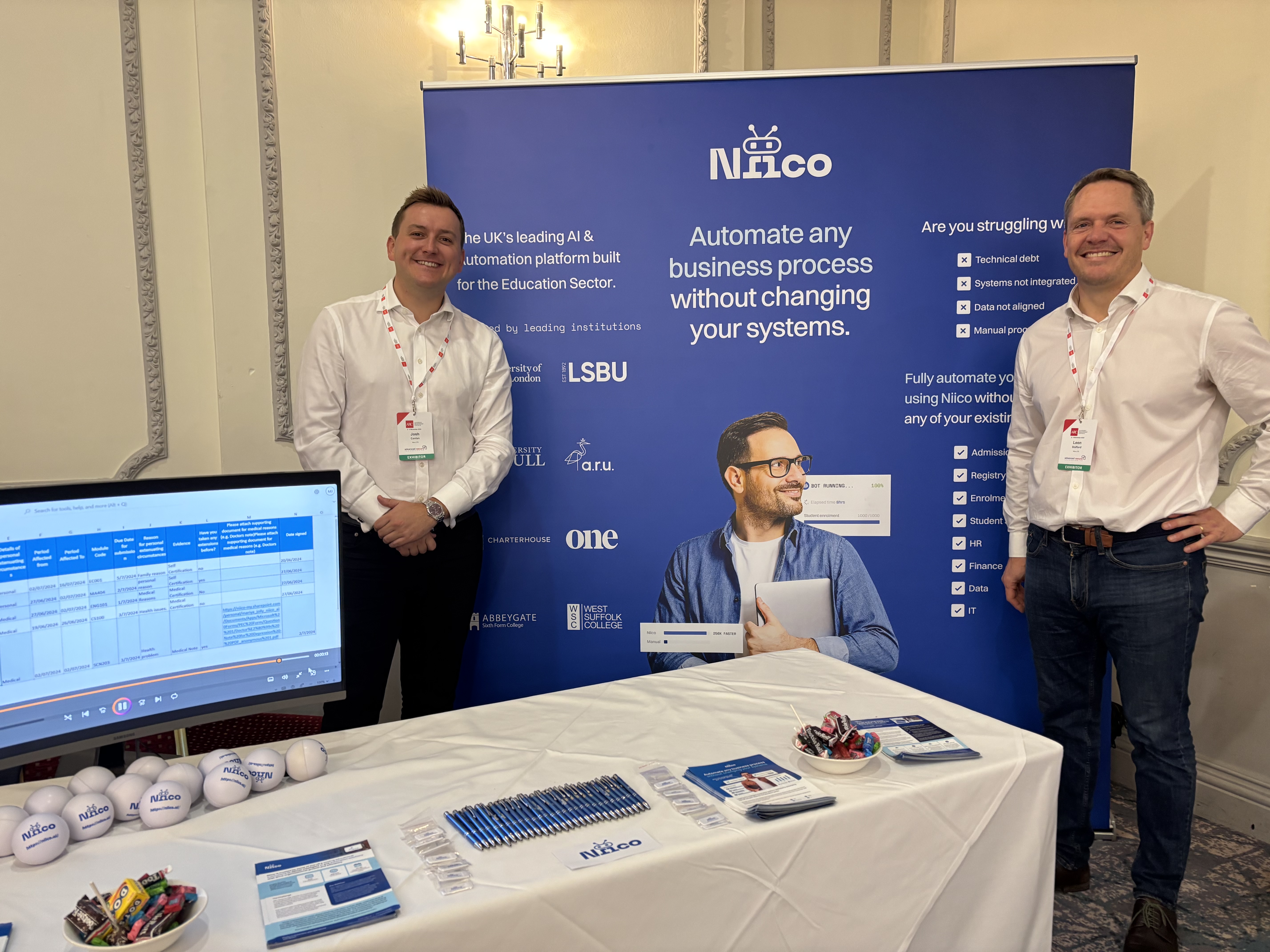
At this year’s ARC Registrar Conference in Bristol, Niico explored how Higher Education Institutions (HEIs) are turning to automation to overcome mounting operational and resource challenges. The event provided valuable insight into the evolving “third space” of higher education, where financial pressures are accelerating the need for change, efficiency, and cross-functional collaboration.
Niico validated our student registry automation capabilities directly with sector leaders. Our products—such as the Personal Extenuating Circumstances (PEC) Agent—resonated strongly with Registrars because they demonstrate clear, short-term return on investment while tackling a familiar, time-intensive process. Delegates also appreciated the ability to evolve these capabilities as institutional needs shift.
Conference Highlights
A sector at a crossroads
One standout moment came from Lee Jones of Leeds Beckett during the Sector at a Crossroads panel. His question—“What single magic-wand change would you make tomorrow for HE?”—sparked candid responses:
-
“Cancel the international student levy and involve students directly in leadership.”
-
“Create a formalised brokerage for structured, budgeted HEI mergers.”
The honesty reflected the urgency and complexity facing institutions today.
Registrar collaboration in action
The Ellucian disruptor session, facilitated by Peter Moss and Julie Kelly, offered a deep dive into the newly emerging LLE legislation. Registrars dissected the implications, exposing the widening gap between policy ambition and capacity for delivery ahead of the tight implementation timeline.
This session highlighted both the strategic challenge and the importance of shared problem-solving across institutions—an increasingly vital part of the AR role.
Emerging automation opportunities
Breakout discussions uncovered several new areas where automation could relieve pressure on Registry teams:
-
LMS to SRS integration
-
Automated Academic Appeals workflows
-
Legislation-specific processes such as those introduced by the Lifelong Learning Entitlement (LLE)
While automation cannot resolve structural or political challenges alone, it can significantly reduce manual effort and improve consistency across complex, high-volume processes.
Why Niico Resonated With Registrars
Many attendees reported severe resource constraints, with some institutions experiencing up to 60% reductions in Registry headcount. With fewer staff and increasing operational demands, Registrars are actively exploring tools that:
-
Reduce manual administrative effort
-
Deliver rapid operational benefit
-
Support long-term strategic flexibility
-
Improve student experience without increasing staffing
Niico’s suite of AI-powered automation capabilities aligned closely with these needs, offering practical, immediate support during a period of intense pressure.
Summary: A Sector Demanding Focus, Collaboration and Action
Registrars are playing an increasingly pivotal role in uniting academic and professional services to deliver a seamless experience for students. As institutions face tough decisions, the traditional separation within the “third space” is giving way to more unified, pragmatic collaboration.
There is less room for posturing—and greater demand for focus, operational clarity, and immediate action.
Niico extends our thanks to Craig Best, the ARC team, and all attendees for a valuable mix of insight, discussion, collaboration, and forward-thinking debate.
Further Reading
For a deeper look at modular study and the shift toward flexible learning pathways, read Julie Kelly’s excellent piece: Modular Study: Putting the Pieces Together
Related articles
-

 Blog
Blog
Learn moreHow to Boost Your Institution’s Application with Seamless MFA Integration
Universities and educational institutions are prime targets for cyber threats, making robust security measures more essential than ever, making Multi-Factor Authentication (MFA) a key solution in safeguarding sensitive student and institutional data.